
car accident Claims
Lending Your Car in Ontario? Here’s Everything You Are Liable For

Book a FREE Consultation
Tell us what happened
We’re here to help.
Table of Contents

Published: May 8, 2026 | Last Reviewed: May 8, 2026
Ontarians are sometimes caught in a dilemma when a friend, family member, or neighbour asks to borrow their vehicle as a favour. While it seems like an innocent ask, your decision to grant that “permission” actually has legal weight.
You might assume that the driver’s responsibility is theirs alone. However, the Highway Traffic Act clearly lays out under section 192(2) that the owner of a vehicle remains on the hook (vicariously liable) for negligence in the use and operation of their motor vehicle.
From an accident victim’s perspective, this is an advantage as they can sue both the driver and the owner of the vehicle. For the owner, however, it can mean higher premiums, a claims history that now includes an accident that they were nowhere near, and the risk of personal exposure if insurance limits are exhausted or any exclusions apply.
How Insurance Follows Your Motor Vehicle in Ontario
The owner’s policy responds first to any claims involving permissive users. The borrower’s own insurance is secondary. Any accident that the borrower may cause will likely be added to your own claims history and may result in higher premiums in the future.
Consent and Permissive Use
The Court of Appeal in Ontario, in a 2015 judgment, ruled that conditional permission, such as “only drive within the city” or “do not go over the speed limit,” does not shield an owner from liability after an accident. Consent exists if the driver possesses the vehicle with permission, regardless of any restrictions.
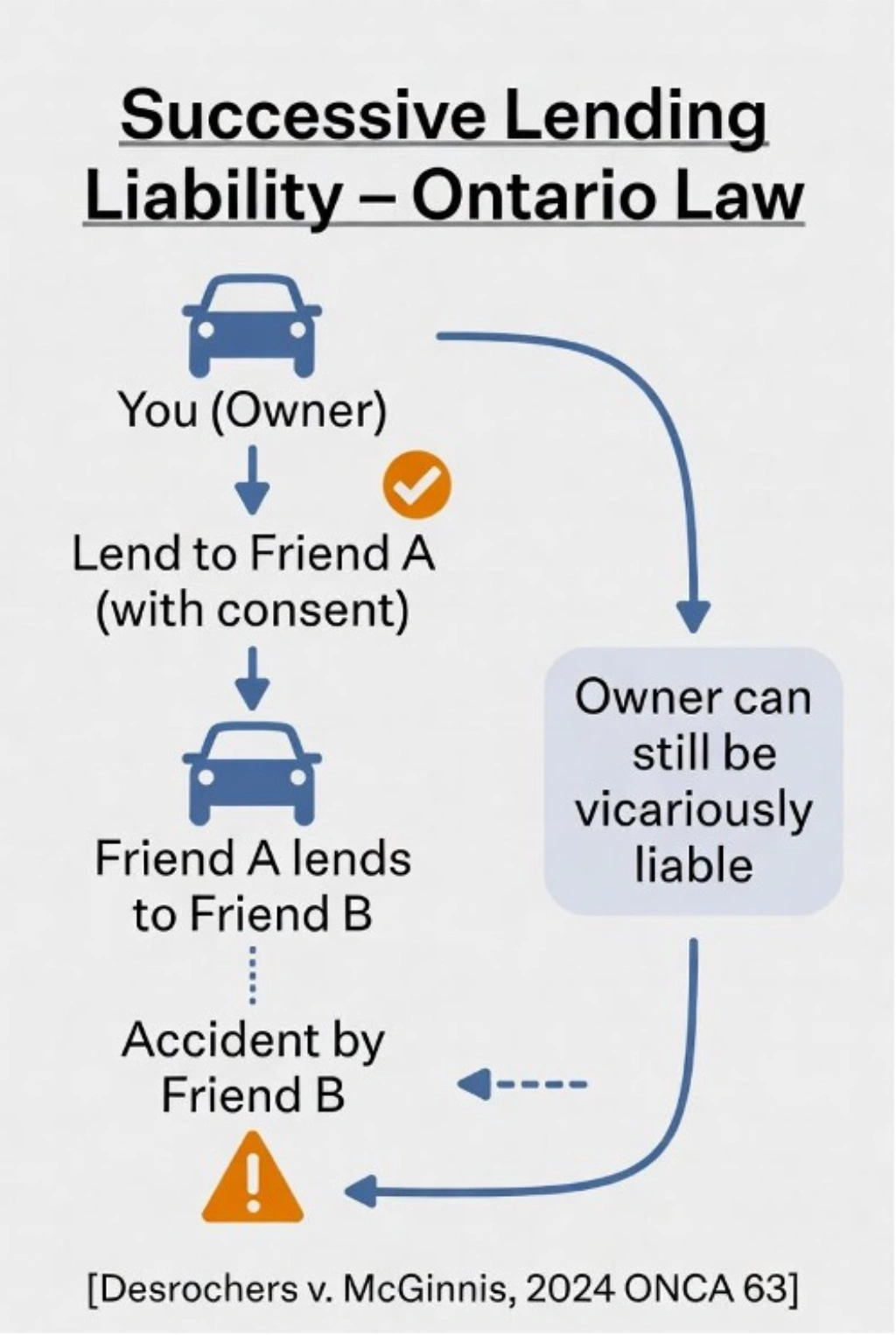
Successive Lending Liability
If you lend your vehicle to a borrower and the borrower subsequently lends it to another person, then the owner may still be responsible for damages sustained by an accident victim, as long as the initial consent exists.
When Can You Be Personally Sued After Lending Your Car?
Owners often assume (incorrectly) that as long as they have insurance, they can never be personally at risk for an accident. However, there are several situations where the owner’s own assets may be exposed:
- Insufficient policy limits: Ontario’s minimum third-party liability limit remains relatively modest compared to the catastrophic losses that can follow a serious collision. If a judgment exceeds your policy limits, you can be pursued personally for the shortfall.
- Excluded drivers: Many policies include an excluded driver endorsement. If you sign such an endorsement excluding, for example, a high-risk family member, and then permit that person to drive anyway, the insurer may be entitled to deny coverage or drastically limit its obligations. In that scenario, the owner can face direct personal liability to injured parties and can also be pursued by the insurer for amounts it was compelled to pay out by statute.
- Breach of policy conditions: Lending your car to someone who you know is unlicensed, impaired, or otherwise prohibited can be characterized as a breach of policy conditions or as negligent entrustment. That may permit the insurer to seek reimbursement from you for what it had to pay out, even if it still had to respond to the victim for public policy reasons.
- Non-disclosure of household members or regular users: In cases where coverage is denied, the owners are then personally liable for damages sustained by accident victims. This is often the case when a primary owner fails to disclose all insured drivers in their household on their policy.
Traffic Violations and Fines
In addition to situations where a person you have lent your car to causes an accident, you can also be held accountable for additional damages. Tickets for speeding, parking, and usage of toll roads are sent to the owners via plates. While any demerit points may go to the driver themself, you may still be responsible for parking and toll charges.
Vehicle Impoundment
Lending your vehicle to suspended or impaired drivers may trigger impoundment:
- If there is a criminal code conviction, then the vehicle is impounded for 45 days;
- If there are proven stunt driving charges, then the vehicle is impounded for 14 days; and
- If there are any HTA violations, then the vehicle may be impounded for 7 days.
The owner has to pay for the cost of towing and storage of the vehicle during this entire duration.
Steps You Should Take Before Letting Someone Borrow Your Vehicle
Before you consent to let any other person borrow your vehicle, there are certain steps you can take to protect your rights and shield yourself from liability:
- Verify the status of their driver’s license. You can determine whether it is valid or not through the MTO online lookup tool
- Confirm through your broker that there are no exclusions on your policy. If there are any restrictions, then state them to the borrower in writing.
- Assess the past driving records of the borrower before allowing them to get behind the wheel.
- Confirm policy disclosure.
- Review your coverage limits.
- If the borrower lives in the same household as you, consider adding them as a secondary driver on your policy.
- If the borrower does not live in the same household as you but borrows your vehicle sometimes, you should consider adding them to your policy as an occasional driver.
What to Do If an Accident Has Already Happened
Although it is best to protect yourself from the outset, if you have allowed another person to borrow your car and a collision has occurred, there are still actions you can take:
- Notify your insurer promptly, even when the driver says that they will handle it themselves.
- Preserve any e-mails, texts, or other forms of communication with the borrower that list what you did and did not authorize. You should also preserve any other correspondence in relation to the lending of the vehicle.
- Avoid informal agreements that may suggest “In case of an accident, you will not get insurance involved”
Has a Car Accident Occurred After You Lent Your Vehicle to Another Person? A Personal Injury Lawyer May Be Able to Help
Many vehicle owners in Ontario do not know that accidents caused by borrowers can be claimed against their own insurance policy. Because insurance follows the vehicle, not the person, it is important to be cautious when lending your car to others and understand your rights in the event of a collision.
At Preszler Injury Lawyers, our Toronto car accident lawyers frequently help clients evaluate claims involving complex liability scenarios and multiple parties. Contact us today to find out how we may be able to help you after a car accident.
Co-Authored by Rajwant (Reagan) Bamel
Personal Injury Lawyer
Lawyer Rajwant (Reagan) Bamel’s practice focuses on personal injury claims, including motor vehicle accident claims, slip and fall claims, and long-term disability claims.
More car accident Topics
Here’s more information on car accident related topics that we think you might find helpful.
car accident
|
May 12, 2026
Civil Claims After an Impaired Driving Collision in Ottawa
When an impaired driver causes a collision in Ottawa, most people think first about criminal charges: Will the driver be charged? Will they lose their…
car accident
|
May 12, 2026
Understanding Impaired Driving Laws in Ontario: What You Need to Know
Impaired driving is one of the most serious criminal and traffic law concerns in Ontario. The law targets anyone operating a motor vehicle while their…
car accident
|
May 12, 2026
What NOT to do After a Car Accident in Ontario
Key Takeaways Ontario’s accident benefits regulation requires notifying your insurer within seven days of the crash if you intend to claim benefits, regardless of fault…
Speak With Our
Legal Team for FREE
Find Out if You Have a Case in Under 5 Minutes
Speak to a Lawyer Now!
We’re here to help.