
car accident Claims
25+ Toronto Traffic Accident Statistics (2026): Fatalities, Trends, and Risk Data

Book a FREE Consultation
Tell us what happened
We’re here to help.
Table of Contents

Published: April 24, 2026 | Last Reviewed: July 3, 2026
Every year, people lose their lives on Toronto’s roads. Often during routine moments: crossing the street, cycling home from work, or making a trip they had made hundreds of times before.
Road safety is a known concern in Canada’s largest city, but the underlying patterns are less understood. When are collisions most likely to turn fatal? Who bears the greatest risk? And is the situation actually improving?
To answer those questions, we examined five years of fatality data published by the Toronto Police Service, covering 2021 through early 2026.
The dataset tracks every traffic-related death in the city, broken down by year, road user type, month, day of week, and time of day.
The findings challenge some common assumptions. Here is what five years of data show about who is at risk on Toronto’s roads, when, and what it means if you or someone you know has been affected by a collision. If you or a loved one has been injured in an auto accident, contact a Toronto car accident lawyer to find out what your options for compensation may be.
Toronto Traffic Fatalities at a Glance
Road safety in Toronto has improved meaningfully over the past five years, but 2024 showed how quickly that progress can reverse. Behind every number in this dataset is a real person: a pedestrian waiting at a crosswalk, a motorcyclist navigating an intersection, a passenger who never made it home. The long-term picture is one of cautious progress, not a solved problem.
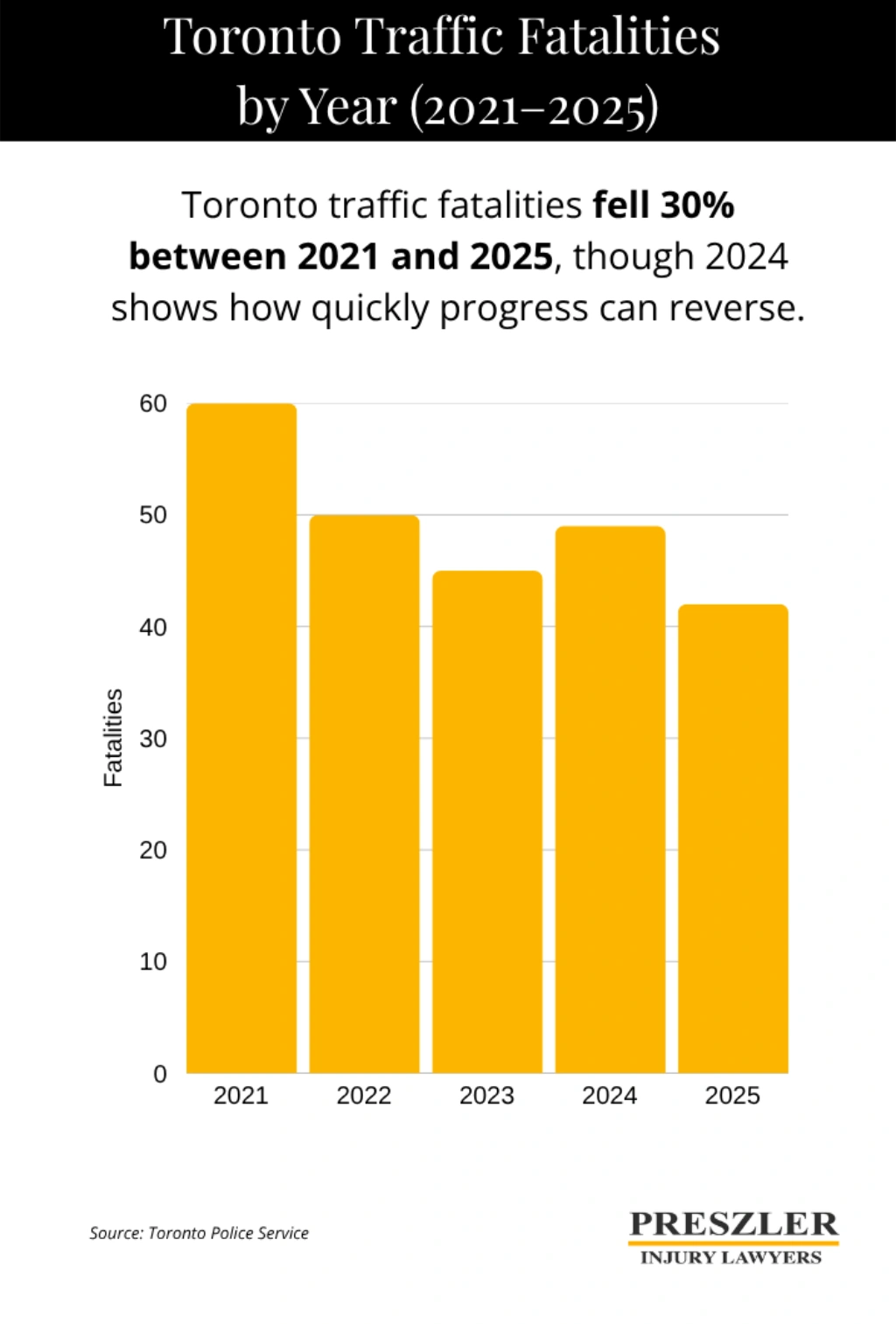
- Toronto recorded 60 traffic fatalities in 2021, the highest in the five-year period.
- Fatalities dropped to 50 in 2022, a 16% year-over-year decline.
- 2023 continued the downward trend, recording 45 fatalities.
- Deaths rose again to 49 in 2024, breaking a three-year downward trend.
- 2025 brought fatalities back down to 42, the lowest full-year total on record.
- Toronto saw a 30% overall reduction in traffic fatalities from 2021 to 2025.
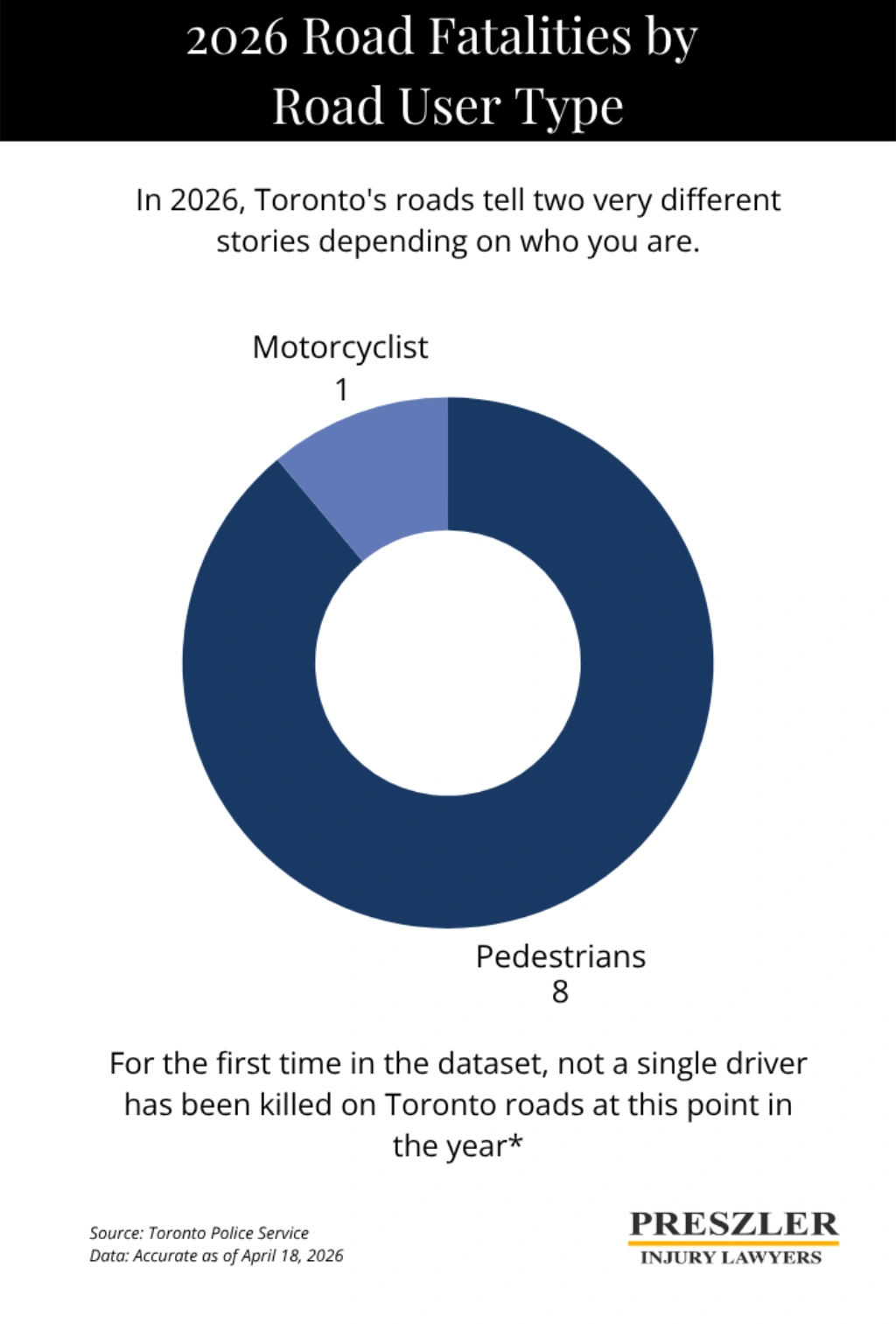
- Through April 18, 2026, the city has recorded 9 fatalities: 8 pedestrians and 1 motorcyclist, making it the worst start to a year for pedestrian deaths in the dataset while simultaneously recording zero driver fatalities.
Who Is Most at Risk on Toronto Roads
Pedestrians account for the majority of traffic deaths in Toronto every single year from 2021 to 2025. In 2026, that pattern has not changed.
When people think about road safety, they often picture driver error or dangerous highway conditions. Data from Toronto tell a different story as the most consistent and overwhelming finding is that pedestrians bear the greatest burden. They are not inside a vehicle. They have no seatbelt, no airbag, and no steel frame around them to shield them from impact. When a collision involving a pedestrian occurs, the consequences are almost always severe. The data reflects this reality year after year, and 2026 has made it impossible to ignore.
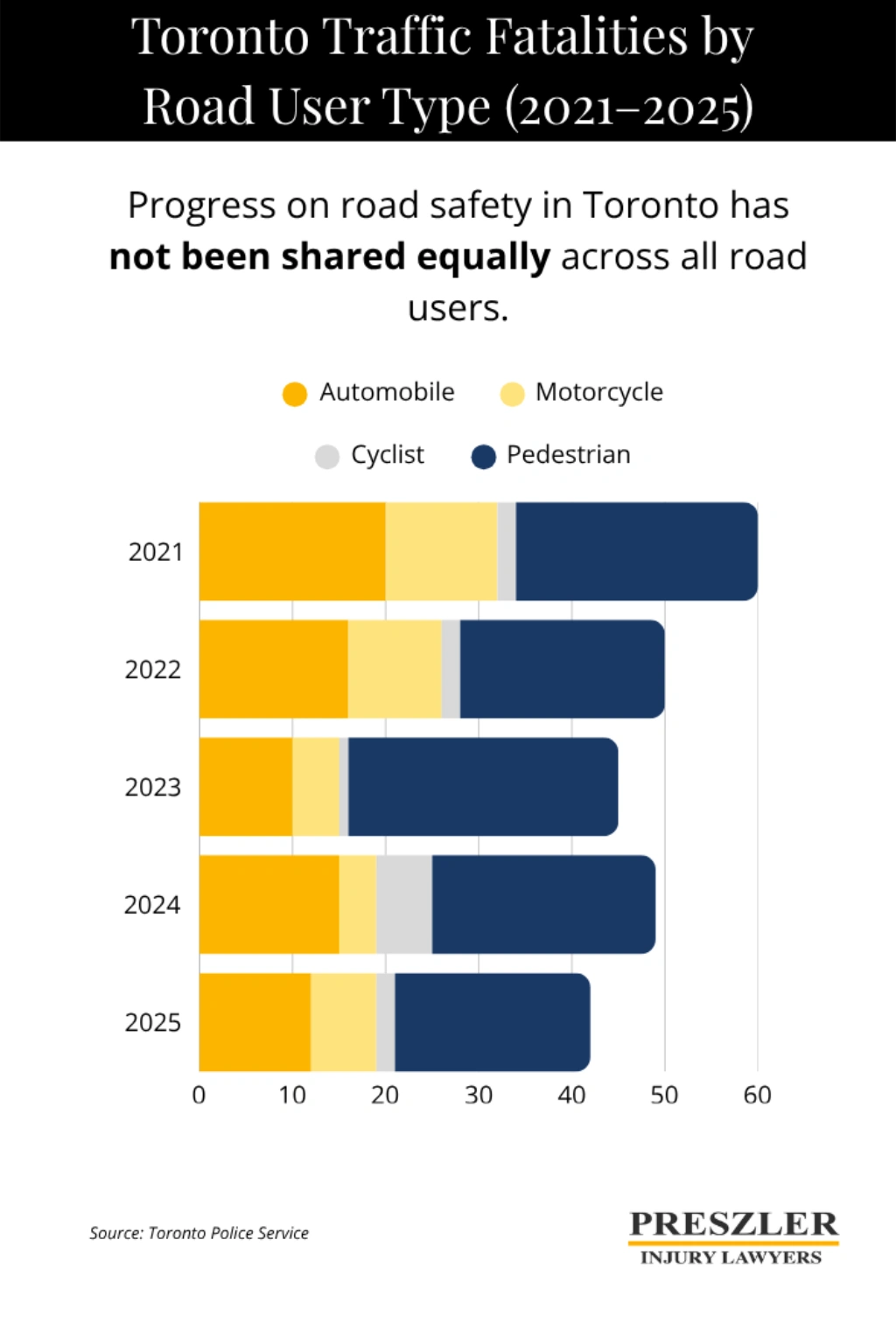
- Pedestrians account for the largest share of traffic fatalities in Toronto in every single year from 2021 to 2025, ranging from 43% to 64% of all deaths.
- In 2023, pedestrians accounted for 64% of all traffic fatalities in Toronto, the highest share in the full five-year period.
- Pedestrian fatalities have never dropped below 21 in any full calendar year.
- Automobile-related fatalities fell from 20 in 2021 to 12 in 2025, a 40% decline.
- Cyclist fatalities surged from just 1 in 2023 to 6 in 2024, a 500% increase in a single year.
- Motorcycle fatalities peaked at 12 in 2021 and have trended downward, reaching 7 in 2025.
- In 2025, pedestrians accounted for 50% of all fatalities, meaning even in Toronto’s safest recent year, one in two road deaths was a pedestrian on foot.
What Time of Day Are Toronto Roads Most Dangerous
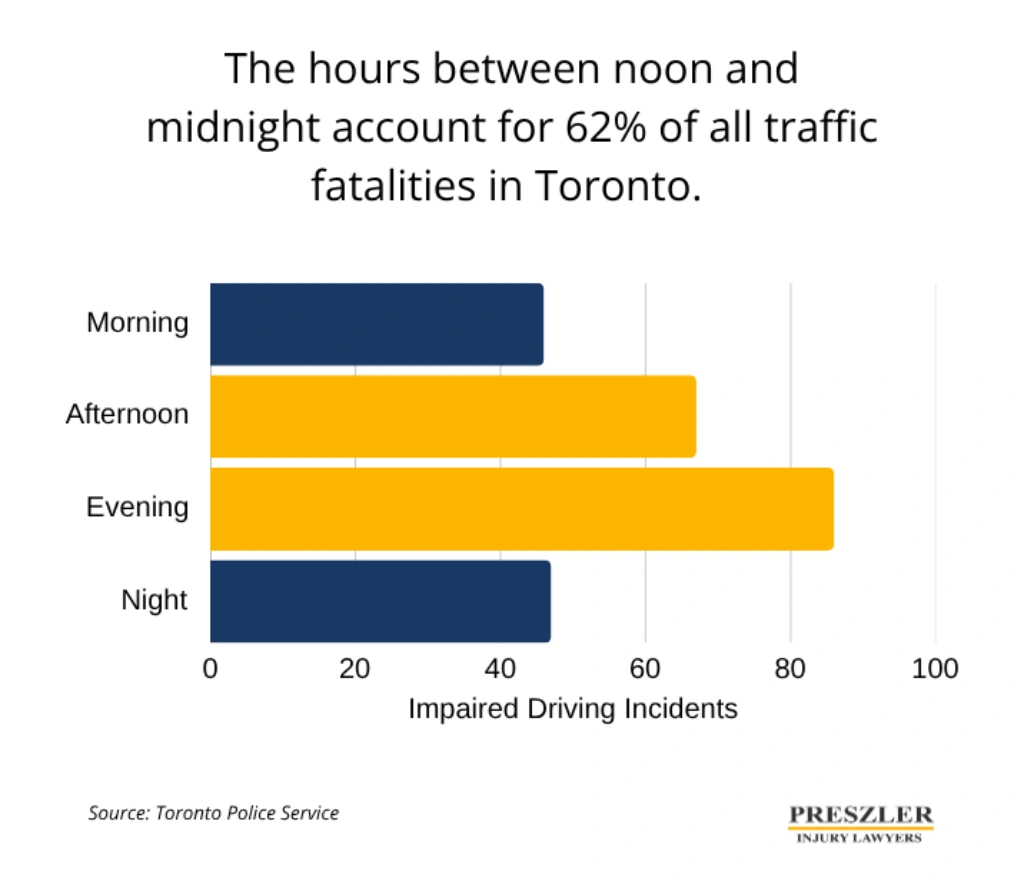
Over five years, 153 of Toronto’s 246 traffic fatalities occurred between noon and midnight. That is 62% of all road deaths happening in the hours most people consider normal, everyday travel time.
This finding surprises most people, as the assumption is that tired or impaired drivers create the most risk after dark. But the Toronto fatality data consistently points to the afternoon and evening as the most dangerous windows. This is likely because more vehicles and pedestrians are on the roads, and the volume of activity creates more opportunities for deadly collisions. The overnight hours account for just 19% of all fatalities over five years, making it the safest time to be on Toronto roads despite its reputation.
- The afternoon window (12pm to 6pm) recorded 67 fatalities over five years, making it the deadliest time block in 4 of the 5 years studied.
- Evening hours (6pm to midnight) recorded 86 fatalities over five years, the highest total of any time block across the full dataset.
- Together, afternoon and evening account for 153 fatalities, or 62% of all Toronto traffic deaths between 2021 and 2025.
- Morning hours (6am to 12pm) recorded 46 fatalities over five years, the second safest window.
- The overnight hours (midnight to 6am) recorded 47 fatalities over five years, counter to the assumption that nighttime driving carries the greatest risk.
Which Months Are Most Dangerous for Toronto Drivers and Pedestrians
July is Toronto’s deadliest month on record. February is the safest. The difference has less to do with weather and road conditions than most people assume. In February, motorcyclists and cyclists are largely absent from city roads, and fewer pedestrians are out. The fatality numbers reflect that absence. As temperatures rise through spring and into summer, that changes. By July, motorcyclists, cyclists, and pedestrians are all back on the road at the same time, sharing space with the same volume of vehicle traffic. That combination is consistently deadly. With warmer weather arriving, the data suggests Toronto road users should treat the coming months with the same caution most people reserve for icy roads in January.
- July recorded 36 fatalities across five years, accounting for 15% of all traffic deaths, making it the single deadliest month in the entire dataset.
- Motorcyclists appear in July’s fatality data every single year from 2021 to 2024, more consistently than any other month.
- Pedestrians were killed in July every single year from 2021 to 2025 without exception, regardless of how high or low the overall total is.
- October recorded 30 fatalities across five years, the second deadliest month, showing that the danger does not end when summer does.
- The three winter months of December, January, and February combined account for 46 fatalities over five years, only 10 more than July alone.
- February recorded just 11 fatalities across five full years, the lowest of any month in there.
- Motorcycle and cyclist fatalities are virtually absent in February across all five years, suggesting that road user exposure is a key driver of seasonal risk patterns.
2026: The Safest Year Ever for Drivers, The Deadliest Start Ever for Pedestrians
Two groups share Toronto’s roads.
For one, 2026 is the safest start on record. For the other, it is the most dangerous.
That gap, between the experience of drivers and the experience of pedestrians, is perhaps the most important finding in this entire dataset. Overall fatality numbers can improve while the people most vulnerable on city streets are simultaneously bearing a greater burden. A declining total is not the same as a safer city for everyone, and with the most dangerous months of the year still ahead, the full picture of 2026 has not yet been written.
Through 18 April 2026, not a single driver has been killed on Toronto’s roads. But eight pedestrians have, along with one motorcyclist. That is the highest pedestrian fatality count at this point in the year across the entire dataset.
What This Means If You Have Been Injured in a Toronto Collision
Ontario’s legal system gives injured victims real options.
Unlike some other provinces, Toronto residents can pursue compensation through the courts, not just through their insurer.
The numbers in this article tell a story about patterns and trends, but behind each number is an individual experience.
A family dealing with the loss of a loved one, an injury that changed the course of someone’s life, or a survivor navigating a system they have never had to engage with before.
If that person is you or someone you know, Ontario’s tort-based legal framework means you have options that go beyond what your insurer will tell you about.
A personal injury lawyer can help you understand what you are entitled to and how to protect your claim from the start. Contact Preszler Law online or call 1-888-608-2111 for a free consultation and learn how we can support your claim.
Co-Authored by Jeffrey A. Preszler
Personal Injury Lawyer
Partner Jeffrey Preszler’s practice focuses on personal injury claims, including motor vehicle accident claims, slip and fall claims, long-term disability claims, and institutional abuse claims.
More car accident Topics
Here’s more information on car accident related topics that we think you might find helpful.
car accident
|
May 12, 2026
Civil Claims After an Impaired Driving Collision in Ottawa
When an impaired driver causes a collision in Ottawa, most people think first about criminal charges: Will the driver be charged? Will they lose their…
car accident
|
May 12, 2026
Understanding Impaired Driving Laws in Ontario: What You Need to Know
Impaired driving is one of the most serious criminal and traffic law concerns in Ontario. The law targets anyone operating a motor vehicle while their…
car accident
|
May 12, 2026
What NOT to do After a Car Accident in Ontario
Key Takeaways Ontario’s accident benefits regulation requires notifying your insurer within seven days of the crash if you intend to claim benefits, regardless of fault…
Speak With Our
Legal Team for FREE
Find Out if You Have a Case in Under 5 Minutes
Speak to a Lawyer Now!
We’re here to help.