
December 24, 2025 | accident benefits Claims
Ontario Tort Claims Explained: What They Are and How They Work

Book a FREE Consultation
Tell us what happened
We’re here to help.
Table of Contents
Tort claims are one of the most common ways injured people in Ontario seek compensation after an accident. While negligence claims make up the majority of tort cases, the law recognizes many types of wrongful acts, including intentional misconduct, unsafe property conditions, and other breaches of legal duty.
In this guide, we explain what a tort claim is, how it differs from other types of legal claims, and what kinds of tort claims you may be able to pursue in Ontario.
If you’ve been injured because of someone else’s wrongful act and think you may have a tort claim, contact Preszler Injury Lawyers for a free consultation to discuss your situation and your possible legal options.
What Is a Tort Claim?
A tort claim is a civil legal claim that allows an injured person to seek compensation from someone whose wrongful act, whether intentional or unintentional, caused harm.
This can include physical injuries, psychological trauma, property damage, or financial losses.

The video above offers a simple explanation: if a person’s negligent act caused your injuries, you may be entitled to recover your damages from them in a lawsuit.
A modern definition of a tort claim includes two main elements:
- It seeks compensation for harm caused by another person’s wrongful act, and
- It can be pursued through a civil lawsuit.
With that foundation in place, it’s important to understand where tort claims fit within Ontario’s legal system.
Civil vs. Criminal Law
Tort claims fall under civil law, not criminal law. Understanding the distinction helps clarify what a tort claim is and what it is not.
Civil Law
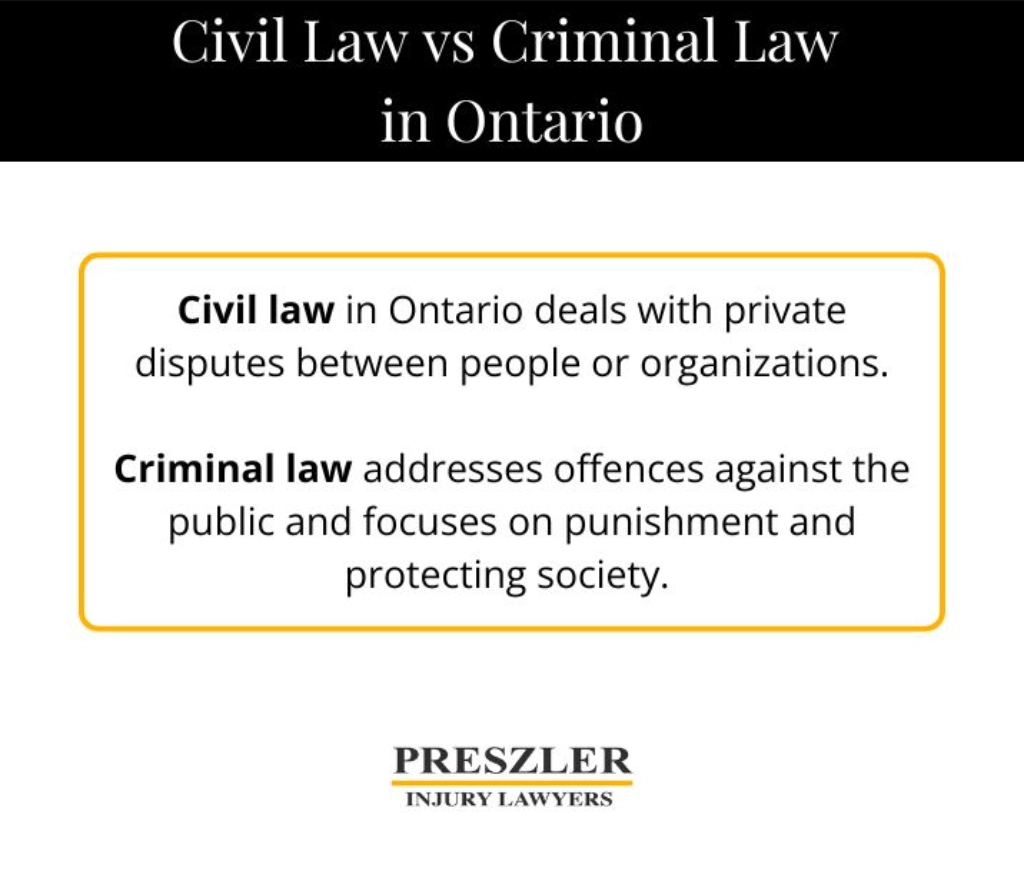
In Ontario, civil law refers to the area of law that deals with disputes between individuals or organizations, including torts, contracts, and property matters.
This meaning is different from the “civil law system” used in other jurisdictions (such as Quebec), which is a separate legal tradition. Here, we’re using the Ontario meaning: non-criminal law involving private disputes.
Civil law focuses on compensation, not punishment.
When someone brings a tort claim, the injured party (the plaintiff) sues the person responsible (the defendant) and must prove that the defendant’s wrongful act caused the harm.
If the plaintiff succeeds, the court may order the defendant to:
- Pay monetary compensation for losses such as pain and suffering, lost wages, or medical expenses
- Do or stop doing something, such as returning property or discontinuing harmful conduct
Unlike criminal cases, civil cases cannot result in imprisonment. The objective is financial recovery and accountability.
Criminal Law
Criminal law is designed to punish actions that violate public laws, such as assault, impaired driving, theft, or homicide.
Instead of an injured person bringing the claim, a government prosecutor brings charges on behalf of society.
Penalties in criminal cases may include:
- Fines
- Probation
- Imprisonment
Criminal law aims to condemn the conduct, deter future wrongdoing, and protect the public.
Tort Claims vs. Other Types of Civil Claims
Civil law includes many types of legal disputes, and tort claims represent just one category.
To better understand what makes tort claims unique, it helps to compare them with other common civil claims.
Contract Claims
Contract claims arise when one party fails to meet its obligations under an agreement.
If a contract is breached, the other party may sue to recover losses and be placed, as closely as possible, in the position they would have been in if the contract had been performed as agreed.
Property Claims
Property claims deal with disputes over ownership, possession, or use of property.
These claims are different from tort claims involving damage to property. For example, a disagreement over who legally owns a piece of land is a property claim, and the remedy may be a court order confirming the rightful owner.
Family Law Claims
Family law matters involve issues such as marriage, separation, divorce, child custody, and child or spousal support.
These claims focus on legal rights and obligations within family relationships. Outcomes may include parenting orders, support payments, or the formal dissolution of a marriage.
Types Of Tort Claims In Ontario
Tort claims are typically grouped as either intentional or unintentional. Tort law can classify claims in several different ways. For example, some torts are grouped by the type of injury involved. Some relate to personal injuries (which may be physical, emotional, or psychological), while others involve only property damage or purely financial harm.
A common way to distinguish torts is by looking at whether intent is one of the required elements. In tort law, the “elements” are the facts a plaintiff must prove for the claim to succeed.
When a tort includes an element of intent, it is considered an intentional tort. When no intent is required, and the wrongdoing arises from carelessness or a failure to act reasonably, it is treated as an unintentional tort.
Intentional Torts
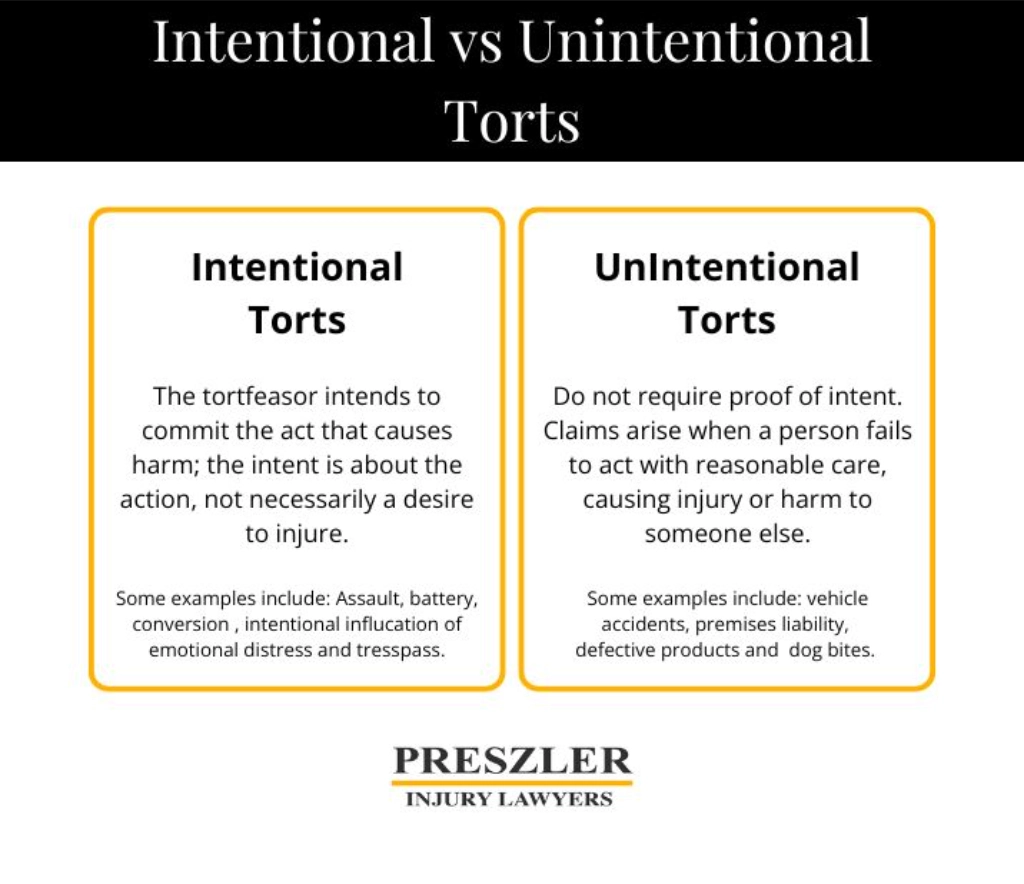
Intentional torts involve situations in which the tortfeasor intended to commit the act that caused harm. The intention relates to the action itself, not necessarily the desire to cause injury.
For example, if someone purposely swings a baseball bat at you and injures you, that may constitute the tort of battery. If the person was carelessly swinging the bat without paying attention and caused injury, the act would typically fall under an unintentional tort, not an intentional one.
Common examples of intentional torts include:
- Assault
- Battery
- Conversion
- Intentional infliction of emotional distress
- Trespass (to land or to personal property)
Unintentional Torts
Unintentional torts do not require proof of intent. Instead, these claims arise when a person fails to act with reasonable care, causing injury or harm to someone else.
In legal terms, this failure to behave reasonably is known as negligence.
Examples of unintentional torts in Ontario include:
- Automobile accidents where one driver is at fault
- Premises liability (slip-and-fall or trip-and-fall incidents)
- Medical malpractice
- Wrongful death
- Dog bites
- Defective products
What Compensation Can You Claim?
If you pursue a tort claim in Ontario, the compensation available depends on the nature and severity of your injuries.
Damages are meant to help you recover financially, physically, and emotionally. Common categories include:
Pain and Suffering (Non-Pecuniary Damages)
This compensates for the impact your injuries have on your daily life, including ongoing pain, emotional distress, and loss of enjoyment of life.
In Canada, these damages are subject to a national cap set by the Supreme Court of Canada in a trilogy of decisions (Andrews v. Grand & Toy, Arnold v. Teno, and Thornton v. School District No. 57)
For motor vehicle accident claims in Ontario, additional rules apply:
- Your injuries must meet a legal threshold to qualify for non-pecuniary damages
- A statutory deductible may be applied to your award
- Deductibles and thresholds are adjusted annually
You can learn more about the compensation you can claim in our guide to pain and suffering damages in Ontario.
Income Loss and Loss of Earning Capacity
If your injuries prevent you from working, you may be entitled to recover the income you’ve lost during your recovery.
In more serious cases, you can also claim for future loss of earning capacity, for example, if you are unable to return to the same job, can only work reduced hours, or can no longer pursue the career path you were on before the injury. Courts assess these losses based on evidence such as medical reports, employment history, and expert opinions.
Medical, Rehabilitation, and Out-of-Pocket Expenses
You can claim reimbursement for past and future expenses related to your injuries. These may include:
- Medical treatment, prescription medication, physiotherapy, chiropractic care, and psychological therapy
- Rehabilitation services and assistive devices
- Transportation to medical appointments
- Home modifications or support services needed because of reduced mobility
- Any other reasonable out-of-pocket expenses caused by the injury
These costs can accumulate quickly, especially when long-term treatment or adaptive equipment is needed.
Family Law Act (FLA) Claims
Section 61 of Ontario’s Family Law Act allows certain close relatives of an injured person to claim their own damages when a loved one is seriously injured or killed. Eligible family members can include:
- Spouses
- Children
- Parents
- Siblings
- Grandparents and grandchildren
Compensation may be available for loss of care, guidance, and companionship, as well as for expenses a family member incurs while caring for or supporting the injured person.
Why These Categories Matter
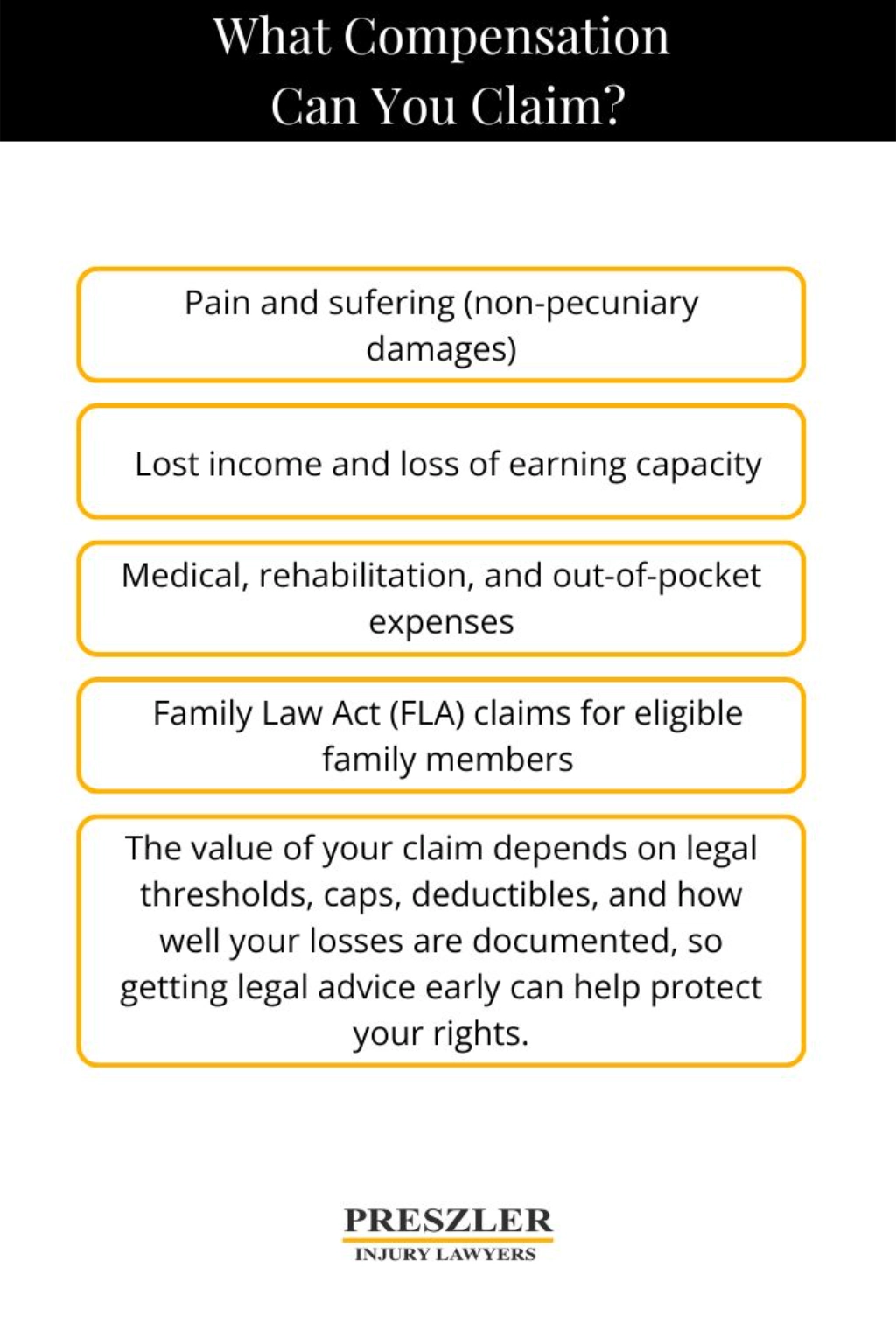
Each head of damages covers a different part of your loss. Some depend on reaching a legal threshold, some are capped, and some require careful documentation to prove. Because these rules can materially affect the value of your claim, receiving legal advice early on can help ensure nothing is overlooked and that your case is properly documented from the start.
Ontario Tort Claim Limitation Periods and Deadlines
Tort claims in Ontario must be started within specific time limits. In most cases, you have two years from the date you knew, or reasonably should have known, that you were injured, that someone else’s actions caused the injury, and that a lawsuit may be appropriate. For many people, this effectively means two years from the date of the accident or incident.
Ontario also has a 15-year ultimate limitation period, which acts as a final cut-off.
After 15 years from the event that caused the injury, a lawsuit generally cannot be started, even if the injury was discovered later.
Missing a limitation period can permanently bar your right to pursue compensation, and delays can make it harder to gather evidence or locate witnesses. If you are unsure which deadlines apply or think you may be close to one, it’s important to speak with a personal injury lawyer as soon as possible to protect your rights.
Contact Our Personal Injury Lawyers For A Free Consultation
If you have been injured because of someone else’s wrongful act, intentional or unintentional, you may have the right to pursue a tort claim. Whether your injuries are physical, emotional, psychological, or financial, speaking with a lawyer can help you understand your options and the compensation you may be entitled to.
Preszler Injury Lawyers has extensive experience representing injured people across Ontario in all types of tort claims. If you have questions about your case, we offer a free, no-obligation consultation, where you can speak with a member of our legal team and receive a case review.
You don’t pay anything unless you choose to hire us and we win your case.
Call 1-888-608-2111 for a free consultation and learn how we can support your claim.
Written by Anna Karlen
Personal Injury Lawyer
Trial lawyer Anna Karlen’s practice focuses on all types of personal injury claims, including catastrophic injury claims and psychiatric injury claims.
Blog Categories
More accident benefits Topics
Here’s more information on accident benefits related topics that we think you might find helpful.

car accident
|
January 21, 2026
Single-Vehicle Accidents: Can You Still Claim Compensation?
You may still be eligible for compensation after a single-vehicle accident, even if you were the only driver involved. Ontario’s no-fault insurance system allows injured…

car accident
|
January 21, 2026
What Happens When an Unlisted Driver Causes a Crash?
When an unlisted driver causes a crash in Ontario, insurance coverage generally still applies, provided the driver had the owner’s permission to use the vehicle….
slip and fall accident
|
January 21, 2026
Choosing The Best Slip and Fall Lawyer In Ontario
Slip and fall accidents can leave you dealing with painful injuries, medical expenses, and a claims process that’s rarely straightforward. On top of trying to…
Speak With Our
Legal Team for FREE
Find Out if You Have a Case in Under 5 Minutes
Speak to a Lawyer Now!
We’re here to help.