
car accident Claims
Navigating Liability in Mixed-Vehicle Collisions

Book a FREE Consultation
Tell us what happened
We’re here to help.
Table of Contents

Published: February 23, 2026 | Last Reviewed: June 10, 2026
Toronto’s streets are denser than ever, forcing heavy trucks, passenger cars, cyclists, and pedestrians to share tight spaces in corridors like Richmond and Adelaide. When these different modes of transport collide, determining fault is rarely straightforward. Ontario law recognizes that a collision between a sedan and a bicycle is fundamentally different from a crash between two cars.
Cases involving mixed vehicle collision liability in Toronto operate under specific rules designed to protect the most vulnerable. A Toronto personal injury lawyer can help examine the facts, apply the “reverse onus” provision, and counter attempts by insurers to shift the blame onto you.
Critical Insights: Mixed-Vehicle Collision Liability in Toronto
- Drivers bear a heavier burden: In collisions involving pedestrians or cyclists, Ontario law presumes the motorist is negligent unless proven otherwise.
- Fault is rarely all-or-nothing: Even if a cyclist or pedestrian violated a traffic rule, shared liability principles may still allow for compensation.
- Commercial trucks face stricter scrutiny: Accidents involving heavy vehicles often trigger complex vicarious liability rules that extend responsibility to trucking companies.
- Location influences liability: High-density corridors like Richmond and Adelaide have specific design features that courts consider when assessing driver awareness.
- Legal counsel protects evidence: A lawyer steps in to preserve traffic camera footage and witness statements before they disappear.
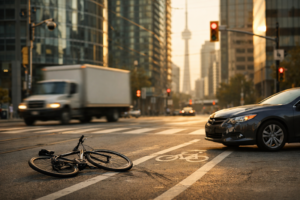
The Hierarchy of Responsibility on Toronto Streets
Liability in Ontario is not always a level playing field. The courts and the Highway Traffic Act recognize a hierarchy of vulnerability. A pedestrian has no protection against a vehicle, and a cyclist has significantly less protection than a truck driver. This reality shapes how liability is assessed in Toronto accidents.
When a heavy commercial vehicle collides with a bicycle or pedestrian, the potential for catastrophic injury is high. Consequently, the duty of care placed on the driver of the larger vehicle is stringent. This does not mean pedestrians and cyclists are immune from traffic laws, but it does mean that drivers of multi-ton vehicles must exercise a higher degree of anticipation and caution.
Understanding the “Reverse Onus” Provision
One of the most distinct aspects of Ontario personal injury law is the “reverse onus” clause found in Section 193(1) of the Highway Traffic Act. In a standard car-vs-car accident, the injured person usually must prove that the other driver was negligent. However, the rules change when a motor vehicle collides with a pedestrian or a cyclist on a public highway.
Under this rule, the law presumes the driver is liable for the collision unless they can prove otherwise. This shifts the strategic balance of the case significantly.
- Automatic Presumption: You do not initially have to prove the driver did something wrong; the court assumes they did until evidence shows otherwise.
- Driver’s Burden: The motorist must provide evidence, such as dashcam footage or witness testimony, to show they acted reasonably and could not avoid the collision.
- Protection for Victims: This rule acknowledges that pedestrians and cyclists often cannot recall the details of a crash due to the severity of their injuries.
- Exceptions Exist: The reverse onus does not apply to collisions between two motor vehicles or accidents that occur on private property (like parking lots).
This provision is a powerful tool for pedestrian accident lawyers in Toronto when establishing the foundation of a claim.
Contributory Negligence in Mixed-Vehicle Accidents
While the reverse onus provides a layer of protection, it does not guarantee a successful claim if the pedestrian or cyclist acted recklessly. Insurance companies frequently argue “contributory negligence” to reduce the amount they must pay. This legal concept asks whether the injured person’s actions contributed to the accident or the severity of their injuries.
Defence lawyers may argue that a cyclist or pedestrian shares fault for the collision. However, shared fault does not eliminate your right to compensation. It simply adjusts the final settlement amount.
- Visibility Issues: Was the cyclist wearing dark clothing at night without proper lights?
- Road Rule Violations: Did the pedestrian jaywalk or cross against a signal?
- Protective Gear: Was the cyclist wearing a helmet? (Note: While not always mandatory for adults, failure to wear one can be used to argue that head injuries were preventable).
- Signaling Failures: Did the cyclist fail to hand signal before a turn?
Even if these factors are present, the driver may still bear the majority of the fault. For example, if a driver was speeding or distracted, their negligence often outweighs a cyclist’s failure to wear a reflective vest. A lawyer helps ensure that any finding of contributory negligence is fair and does not unjustly wipe out your claim.
Commercial Vehicle Dynamics and Vicarious Liability
Collisions involving commercial trucks, delivery vans, or public transit vehicles introduce an additional layer of complexity: vicarious liability. In these scenarios, liability often extends beyond the individual driver to the company that owns the vehicle. Commercial drivers are professional operators held to high standards. When a delivery truck turns right at a busy intersection like King and Spadina and strikes a cyclist in the blind spot, multiple parties may be responsible.
The driver’s responsibility
The driver is the primary defendant if operational errors caused the crash. This includes speeding, failing to check mirrors, or aggressive driving. Professional drivers are expected to manage their blind spots effectively, especially in areas with heavy bicycle traffic.
The trucking company’s role
The company may be liable for failing to maintain the vehicle or for negligent hiring practices. If a company pushes drivers to violate hours-of-service regulations, resulting in fatigue, they share the blame for the accident.
Cargo and logistics
Liability can also extend to cargo loaders if shifting weight caused the truck to become unstable or difficult to control. In rare cases, the municipality may be involved if road design or a lack of signage contributed to the hazard. Vicarious liability ensures that there are sufficient insurance resources available to cover the extensive damages often caused by heavy trucks.
The Vulnerable Road User Protection Act
Ontario continues to update its laws to reflect the dangers faced by non-motorized road users. Recent legislative changes and proposed acts, often referred to as protecting “vulnerable road users,” influence how courts and insurers view these accidents. These measures aim to increase penalties for drivers who injure pedestrians and cyclists.
From a civil liability perspective, these laws reinforce the high duty of care drivers owe to the public. When a driver violates a statute explicitly designed to protect vulnerable users, such as the requirement to leave one meter of space when passing a cyclist, it serves as strong evidence of negligence.
High-Risk Zones in Toronto
Certain areas in Toronto are hotspots for mixed-vehicle collisions due to infrastructure changes and density. Lake Shore Boulevard sees high speeds mixed with recreational cyclists crossing trails, while the Gardner Expressway ramps involve fast-moving cars merging into city traffic, where pedestrians cross.
Additionally, corridors like Dundas and Queen Streets present “dooring” hazards due to streetcar tracks and narrow lanes. Dooring accidents occur when a motorist opens a vehicle’s door in the path of a cyclist.
If your accident occurred in one of these zones, local knowledge is a powerful tool. Understanding traffic flow patterns and signal timing at specific intersections helps construct a stronger argument for driver negligence. Toronto bicycle accident lawyers frequently utilize traffic experts to analyze these specific road conditions.
Joint and Several Liability in Multi-Party Crashes
In dense traffic conditions, an accident is often the result of a chain reaction involving multiple drivers. For example, a car might cut off a delivery truck, causing the truck driver to swerve into a bike lane and strike a cyclist. In these complex scenarios, determining who pays for the damages can be confusing for the victim.
Ontario applies the principle of “joint and several liability” to these situations. This legal doctrine is vital for protecting innocent victims in mixed-vehicle collision cases. It ensures that an injured person can recover full compensation even if one of the at-fault parties cannot pay.
How Joint Liability Protects You
If the court finds that two or more defendants (e.g., the car driver and the truck driver) are responsible for your injuries, they are jointly and “severally” liable. This means if one defendant is uninsured or has insufficient coverage, the other defendant must cover the remaining damages. This rule simplifies collection, preventing you from being caught in the middle of a finger-pointing match between insurance companies while you are trying to recover.
The goal of this rule is to prioritize the victim’s recovery over the defendants’ financial disputes. A lawyer can help identify all potential defendants, from the drivers to the municipalities responsible for road maintenance, to maximize the available insurance limits for your claim.
Steps to Take After a Mixed-Vehicle Accident
Once the initial shock of the collision subsides and you have returned home from the hospital, the administrative reality of the accident begins. The days following a crash are valuable for building a legal case. While your health is the priority, the steps you take now can preserve your ability to access benefits later.
To protect your claim while you recover, consider these actions:
- Consult a Lawyer Immediately: Insurance adjusters often seek recorded statements early in the process to limit their liability. Speaking with a car accident lawyer before engaging with insurance companies protects you from inadvertently damaging your claim or admitting fault where none exists.
- Document Your Recovery: Keep a daily journal detailing your pain levels, mobility limitations, and how the injury affects your daily routine.
- Follow Medical Advice: Attend all follow-up appointments and physiotherapy sessions; missing them can signal to insurers that your injuries are not severe.
- Preserve Physical Evidence: Do not repair your bicycle or wash the clothing you were wearing during the crash, as rips and tears can help reconstruct the point of impact.
- Limit Social Media: Avoid posting updates or photos of your recovery, as defence lawyers frequently monitor these platforms to dispute injury claims.
Taking these steps creates a documented timeline of your suffering and compliance. This evidence makes it much harder for an insurance adjuster to downplay the impact the accident has had on your life. For more information on what benefits are available immediately, review our guide on accident benefits in Ontario.
FAQs: Determining Fault in Complex Mixed-Traffic Collision Cases
Does the “Reverse Onus” apply if the accident happened in a parking lot?
Generally, no. The reverse onus provision in the Highway Traffic Act specifically applies to collisions on public highways (streets and roads). Accidents that occur on private property, such as grocery store parking lots or private driveways, typically follow standard negligence rules.
In these cases, the injured pedestrian or cyclist must prove that the driver was negligent. However, ordinary traffic rules are still used as a benchmark to determine what constitutes reasonable behavior.
What if I was involved in a hit-and-run as a pedestrian?
If the driver flees the scene and cannot be identified, you still have options for compensation. You may be able to claim benefits through your own auto insurance policy if you have one.
If you do not have auto insurance, you can apply to the Motor Vehicle Accident Claims Fund (MVACF). This government-run payer of last resort provides compensation to victims injured by uninsured or unidentified drivers.
How long do I have to file a lawsuit after a collision?
In Ontario, the standard limitation period to file a lawsuit for personal injury is two years from the date of the accident. However, there are much shorter deadlines for notifying the at-fault party and applying for accident benefits (often as short as 7 or 30 days).
Failing to meet these strict timelines can jeopardize your ability to recover damages. It is wise to consult a lawyer immediately to ensure all procedural deadlines are met.
Can I still claim compensation if I wasn’t wearing a bicycle helmet?
Yes, you may still pursue a claim. While Ontario law requires cyclists under 18 to wear a helmet, it is not mandatory for adults. However, the defence may argue contributory negligence if you suffered a head injury. They must prove that a helmet would have prevented or reduced the severity of that specific injury.
If your injuries are unrelated to your head (e.g., a broken leg or spinal injury), the lack of a helmet is generally irrelevant to the liability analysis.
What damages can I recover in a mixed-vehicle accident lawsuit?
Victims of serious collisions may seek compensation for various losses. These include general damages for pain and suffering, loss of income (both past and future), and cost of future care (such as home modifications or long-term therapy). Additionally, family members may file a claim under the Family Law Act for the loss of guidance, care, and companionship caused by the victim’s injuries.
Contact Preszler Injury Lawyers Today
If you or a loved one has suffered a catastrophic injury due to negligence in Toronto, contact the personal injury trial lawyers other attorneys trust. The rules governing mixed-vehicle accidents are distinct, and early intervention is necessary to protect your rights.
Call Preszler Injury Lawyers or contact us online today for a free, confidential consultation to discuss your case. You do not pay unless we recover money for you.
Authored by Preszler Injury Lawyers
Personal Injury Law Firm
Preszler Injury Lawyers represents injured people across Ontario in personal injury matters, including motor vehicle accident claims, slip and fall claims, long-term disability claims, and institutional abuse claims.
More car accident Topics
Here’s more information on car accident related topics that we think you might find helpful.
car accident
|
May 12, 2026
Civil Claims After an Impaired Driving Collision in Ottawa
When an impaired driver causes a collision in Ottawa, most people think first about criminal charges: Will the driver be charged? Will they lose their…
car accident
|
May 12, 2026
Understanding Impaired Driving Laws in Ontario: What You Need to Know
Impaired driving is one of the most serious criminal and traffic law concerns in Ontario. The law targets anyone operating a motor vehicle while their…
car accident
|
May 12, 2026
What NOT to do After a Car Accident in Ontario
Key Takeaways Ontario’s accident benefits regulation requires notifying your insurer within seven days of the crash if you intend to claim benefits, regardless of fault…
Speak With Our
Legal Team for FREE
Find Out if You Have a Case in Under 5 Minutes
Speak to a Lawyer Now!
We’re here to help.