
January 7, 2026 | personal injury Claims
Debunking Common Myths About Personal Injury Claims in Ontario

Book a FREE Consultation
Tell us what happened
We’re here to help.
Table of Contents
Personal injury claims in Ontario are often shrouded in misinformation. Whether it’s advice from a well-meaning friend, a post on social media, or a confusing conversation with an insurance adjuster, many people walk away from valid claims because they don’t understand how personal injury law in Ontario actually works.
These myths can be costly. They can lead to missed deadlines, incomplete medical documentation, and early settlements that fail to account for long-term pain, lost income, or future care needs. In some cases, people assume they have no rights at all, even though the law may provide multiple paths to compensation depending on how and where the injury occurred.
This guide addresses some of the most common misconceptions about personal injury claims in Ontario.
Whether your injury resulted from a motor vehicle accident, a slip-and-fall, or another form of negligence, understanding these myths can help you make informed decisions and protect your rights.
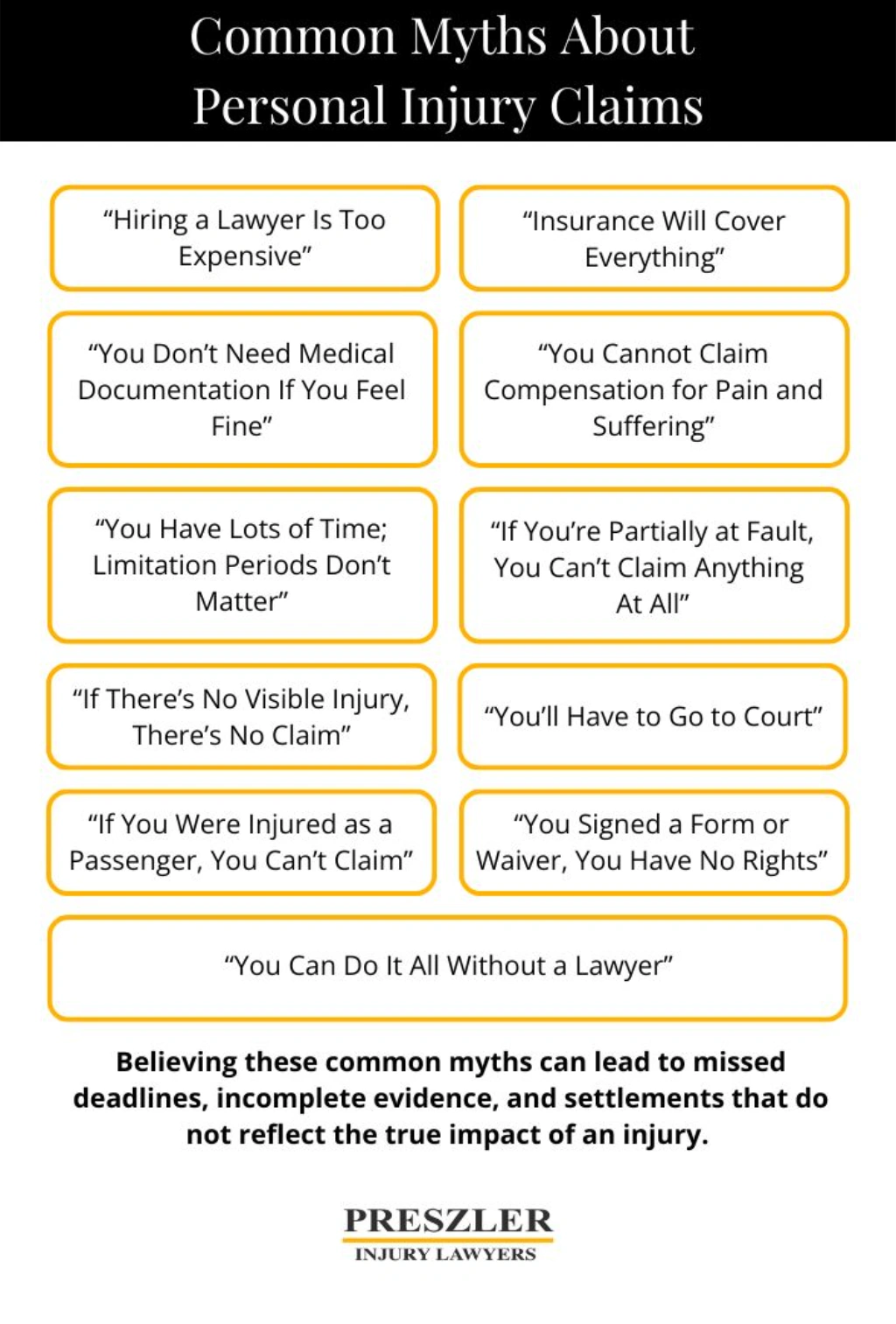
11 Common Myths About Personal Injury Claims in Ontario
1. “Hiring a Lawyer Is Too Expensive”
One of the most common reasons people avoid pursuing a personal injury claim is the belief that hiring a lawyer will cost more than the claim is worth.
In Ontario, most personal injury lawyers work on a contingency fee basis, meaning there are no upfront legal fees and no hourly billing.
The lawyer is paid only if the claim is successful, and their fee is typically a percentage of the compensation recovered. Even better, the more compensation you get, the more the lawyer earns, so your interests are aligned. If there is no recovery, legal fees are generally not owed.
This structure is designed to improve access to justice, particularly for people who are already dealing with medical bills, missed work, and financial stress after an injury. In addition, initial consultations are often free and without obligation.
This allows injured individuals to understand their rights, the potential value of a claim, and the risks involved before deciding how to proceed.
While every case is different, the idea that legal help is only for the wealthy is a myth that prevents many people from getting accurate advice when it matters most.
2. “You Cannot Claim Compensation for Pain and Suffering”
Many people assume that personal injury claims only cover out‑of‑pocket expenses, such as medical bills or lost income.
In Ontario, this is incorrect.
Compensation for pain and suffering, also known as non-pecuniary damages, is available in many types of personal injury cases, including motor vehicle accidents, slip-and-fall accidents, abuse claims and other negligence claims.
In motor vehicle cases, special rules apply. A legal threshold and a statutory deductible can limit recovery, often leading to the mistaken belief that pain and suffering cannot be claimed at all or that loss of income is not recoverable.
Outside of motor vehicle accidents, different legal principles may apply. In slip-and-fall claims, occupier’s liability cases, and other negligence claims, pain and suffering damages are assessed based on the nature of the injury, its impact on daily life, and the long-term prognosis.
As these assessments are highly fact-specific, early legal advice from a reputable firm such as Preszler Injury Lawyers can help clarify the compensation available. Contact Preszler Injury Lawyers for a free consultation to discuss your situation and your possible legal options.
3. “You Don’t Need Medical Documentation If You Feel Fine”
In the adrenaline of a collision on the 401 or a fall in a grocery store, you might not immediately notice the harm you’ve sustained. It’s common for people to assume that if they feel “okay” after an accident, there’s no need to see a doctor or document what happened.
In reality, early medical assessment and documentation are one of the most important steps in protecting both your health and any potential personal injury claim.
Many injuries do not present immediate or obvious symptoms. Concussions, soft-tissue injuries, back and neck injuries, and psychological conditions can develop or worsen days or even weeks later. Without early medical records, it becomes more difficult to link those symptoms to the incident.
Medical documentation also plays a key role in credibility.
Insurers and defendants rely on treatment notes, referrals, diagnostic imaging, and follow-up records to assess the severity and impact of an injury.
Ongoing documentation helps show how symptoms affect daily activities, work, and quality of life over time, even if you initially felt fine.
4. “Insurance Will Cover Everything”
Many people assume that once insurance is involved, all losses related to an injury will be covered.
In Ontario, this is rarely the case.
In motor vehicle accidents, Statutory Accident Benefits (SABS) may provide limited coverage for medical treatment, rehabilitation, and a portion of lost income, regardless of fault. These benefits apply provided a motor vehicle is involved in the collision.
All other losses may be pursued through a tort claim, which requires another party to be at least one percent at fault. For motor vehicle accident victims, recovery may be further limited by the statutory deductible and the statutory threshold, which can bar compensation for pain and suffering and future health care expenses unless the injuries meet the required level of seriousness. Additional limits may also apply to past income loss damages.
In slip-and-fall and other occupier’s liability claims, compensation is often pursued through the property owner’s liability insurance. While insurance may be available, coverage depends on the policy terms and does not automatically account for long-term income loss, future care needs, or pain and suffering.
Insurance companies are also not neutral advisors.
Their role is to assess claims within the scope of the policy and manage costs, not to ensure full legal compensation. This is why insurance coverage alone often falls short in a personal injury claim.
5. “You Have Lots of Time; Limitation Periods Don’t Matter”
A common and costly misconception is that personal injury claims can be handled whenever it’s convenient.
In Ontario, strict limitations and notice periods apply, and missing them can permanently bar a claim, regardless of how strong it may be.
In most personal injury cases, there is a two-year limitation period to start a lawsuit. This period generally begins when a person knew, or ought reasonably to have known, that they were injured and that the injury may be connected to someone else’s conduct.
In addition to the two-year limit, some claims have much shorter notice requirements. For example, slip and fall claims involving snow and ice on private property may require written notice within 60 days of the incident. These shorter deadlines are easy to miss and can defeat a claim long before the general limitation period expires.
6. “If You’re Partially at Fault, You Can’t Claim Anything”
Many people believe that if they contributed in any way to their injury, they are automatically barred from recovering compensation.
In Ontario, this is not how personal injury law works.
Ontario follows the principle of contributory negligence, which allows courts to divide responsibility between the parties involved. If an injured person is found to be partially at fault, their compensation may be reduced in proportion to their share of responsibility, but the claim itself is not eliminated.
This principle applies across many types of personal injury claims.
For example, a person injured in a slip-and-fall may be found partially responsible for ignoring warning signs or proceeding through a hazard when they knew it was treacherous. In motor vehicle cases, failing to wear a seatbelt can also reduce damages.
In each of these situations, partial fault affects the amount of compensation, not the right to pursue a claim.
7. “If There’s No Visible Injury, There’s No Claim”
A lack of visible injuries does not mean a person was not seriously hurt. Many legitimate personal injury claims involve injuries that are not obvious but still have a significant impact on daily life.
As noted earlier, injuries such as soft-tissue damage, concussions, chronic pain, nerve injuries, and psychological conditions like anxiety, depression or post-traumatic stress often do not involve visible signs like bruising or fractures.
Despite this, they can affect concentration, mobility, sleep, work performance, and overall quality of life.
Personal injury law does not require an injury to be visible to be compensable. What matters is whether the injury affects a person’s functioning and well-being, not whether it can be seen from the outside.
8. “You’ll Have to Go to Court”
Many people avoid pursuing a personal injury claim because they assume it will inevitably lead to a courtroom trial.
The majority of personal injury claims resolve through negotiation, mediation, or settlement before trial.
While litigation may involve formal steps such as exchanging documents, examinations for discovery, and mediation, these processes are designed to encourage resolution and narrow the issues in dispute.
Trials are generally reserved for cases where liability or damages cannot be resolved through other means.
Understanding that trials are not the default option often removes an unnecessary barrier that prevents people from asserting their rights.
9. “If You Were Injured as a Passenger, You Can’t Claim”
Passengers are often unsure of their rights after an injury, especially when the driver is a friend or family member. In Ontario, being a passenger does not prevent someone from pursuing compensation.
In many cases, injured passengers may be entitled to benefits and may also have the right to bring a claim against the at-fault party, whether that is the driver of the vehicle they were in or another responsible party. These claims are typically made through insurance coverage, not against a loved one’s personal assets.
Because passengers are rarely responsible for causing an accident, their claims often involve fewer liability disputes. Understanding this can help prevent valid claims from being delayed or abandoned due to unnecessary concern or misplaced guilt.
10. “You Signed a Form or Waiver, You Have No Rights”
Signing a waiver or release does not automatically eliminate the right to pursue a personal injury claim. In Ontario, waivers are not absolute, and their enforceability depends on the circumstances.
Courts consider how a waiver was drafted, whether it was clearly explained, and whether the person signing it had a genuine opportunity to understand what rights they were giving up. Factors such as unclear wording, unequal bargaining power, or failing to draw attention to key terms can limit or defeat a waiver’s effect.
In Occupiers’ Liability cases, such as injuries at gyms, recreational facilities, or commercial properties, the Occupiers’ Liability Act (OLA) requires property owners and occupiers to take reasonable steps to keep people safe.
A signed waiver does not excuse negligence in every situation and should never be assumed to be the end of a claim without proper legal review.
11. “You Can Do It All Without a Lawyer”
Some people assume they can handle a personal injury claim on their own, especially when an insurer appears cooperative at the outset. In practice, self-represented claimants often face challenges they don’t anticipate.
Common issues include missed limitation or notice deadlines, incomplete medical or expert evidence, and undervaluing the long-term impact of an injury. Early settlement offers may address immediate expenses but often fail to account for future care needs, ongoing pain, or reduced earning capacity.
A personal injury lawyer’s role goes beyond filing paperwork. It includes identifying all potential sources of compensation, accurately assessing damages, and negotiating with insurers or defendants who regularly handle these claims.
Having legal representation helps level the playing field and reduces the risk of accepting an outcome that does not reflect the true cost of an injury.
Contact Preszler Injury Lawyers Today for a Free Consultation
Believing common myths about personal injury law can lead to missed deadlines, incomplete evidence, and settlements that do not reflect the true impact of an injury.
Taking the time to understand your rights, document your symptoms, and seek informed legal advice can help protect your long-term well-being and financial security.
If you’ve been injured and are unsure how these issues apply to your situation, Preszler Injury Lawyers offers free, no-obligation consultations and represents clients across Ontario on a contingency fee basis, meaning there are no upfront legal fees and you pay nothing unless compensation is recovered.
Getting informed early can make a meaningful difference.
To speak with a lawyer, call 1-888-608-2111 or use our online contact form to schedule your free consultation.
Written by Jeffrey A. Preszler
Personal Injury Lawyer
Partner Jeffrey Preszler’s practice focuses on personal injury claims, including motor vehicle accident claims, slip and fall claims, long-term disability claims, and institutional abuse claims.
Blog Categories
More personal injury Topics
Here’s more information on personal injury related topics that we think you might find helpful.
dog bite
|
January 21, 2026
Proving a Dog Bite Claim in Ontario
Ontario uses a strict liability approach for dog bite cases. This means the dog’s owner is responsible for the injuries their dog causes, even if…

accident benefits
|
January 21, 2026
Why You Should Name All Drivers in Your Household On Your Auto Insurance
In Ontario and most other provinces across Canada, all motorists are required to have auto insurance. You cannot drive a motorized vehicle on public roads…

accident benefits
|
December 24, 2025
Ontario Tort Claims Explained: What They Are and How They Work
Tort claims are one of the most common ways injured people in Ontario seek compensation after an accident. While negligence claims make up the majority…
Speak With Our
Legal Team for FREE
Find Out if You Have a Case in Under 5 Minutes
Speak to a Lawyer Now!
We’re here to help.