
car accident Claims
Can You Sue Someone for Road Rage in Ontario?

Book a FREE Consultation
Tell us what happened
We’re here to help.
Table of Contents

Published: April 14, 2021 | Last Reviewed: June 10, 2026
Toronto drivers know the frustration of gridlock on the Don Valley Parkway or the endless construction delays on the Gardiner Expressway. However, when that frustration boils over into violence, innocent commuters often pay the price. If you were injured by an aggressive driver, you are likely facing not just physical pain, but confusion about how the law handles “intentional” crashes.
Suing for road rage in Ontario is a complex legal process because it blurs the line between a standard car accident and a criminal assault. An experienced car accident lawyer can steer you through the insurance loopholes that often arise in these cases, so that the driver’s anger does not prevent you from receiving the compensation you need to recover.
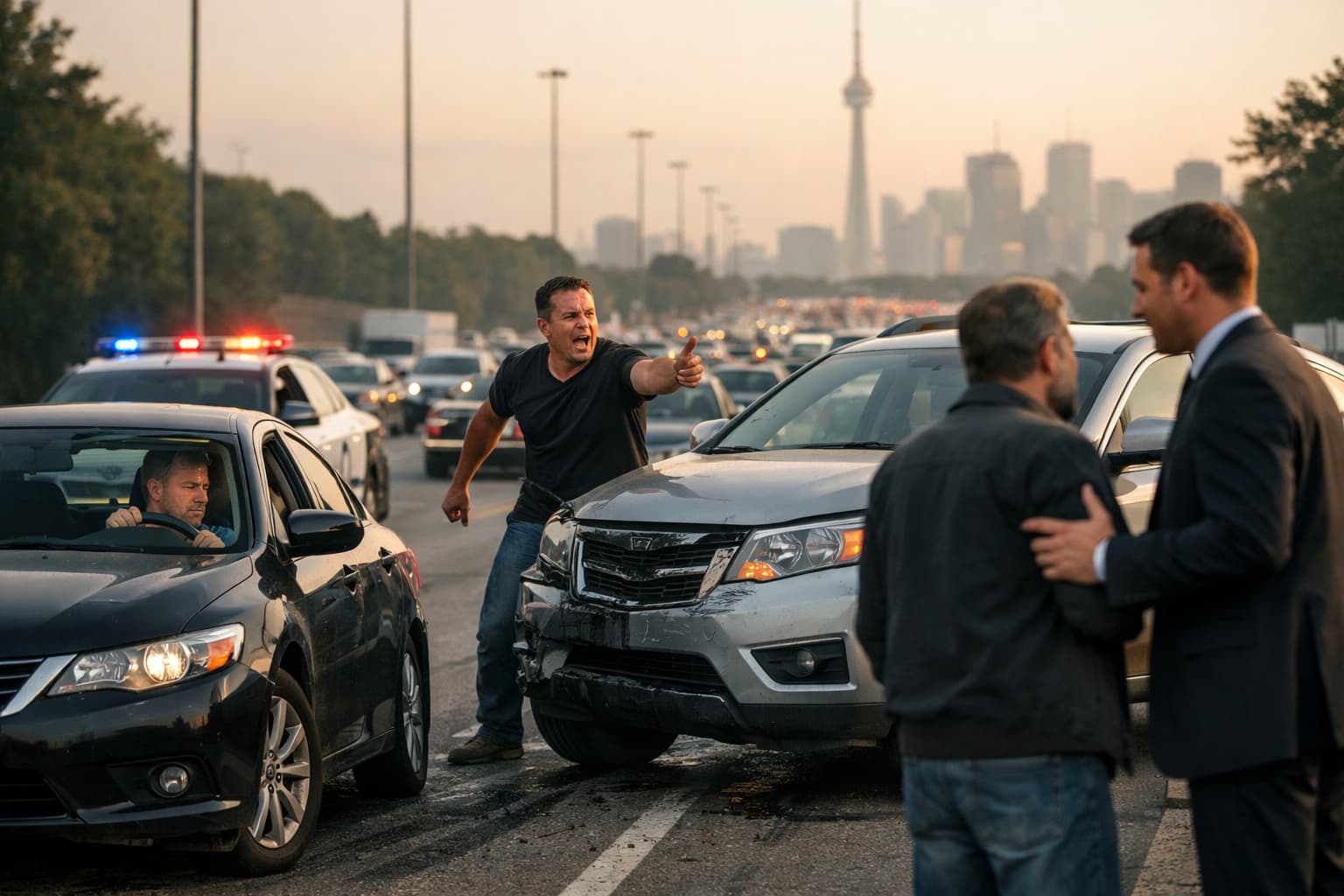
Critical Insights: When a Road Rage Incident Becomes a Lawsuit
- Intent matters for insurance: Proving a driver acted negligently rather than intentionally is often required to trigger insurance coverage for your damages.
- Criminal charges support civil claims: A conviction for assault with a weapon or stunt driving serves as powerful evidence in your lawsuit.
- No-Fault benefits still apply: You are entitled to Statutory Accident Benefits (SABS) for medical care regardless of why the other driver hit you.
- Punitive damages are possible: Courts may award extra compensation specifically to punish the at-fault driver for malicious behavior.
- Evidence is time-sensitive: Dashcam footage from the 401 or DVP is often the only way to prove the other driver’s aggression was the primary cause.
What Constitutes Road Rage Under Ontario Law?
Road rage is not a single specific crime in the Criminal Code; rather, it is a label used to describe a cluster of dangerous behaviors that can lead to both criminal and civil liability. In the context of a personal injury claim, we must define the behavior legally to establish fault.
Road rage typically encompasses:
- Tailgating: Following too closely at high speeds on highways like the 401 through North York to intimidate another driver.
- Brake Checking: Intentionally slamming on brakes to cause a rear-end collision.
- Cutting Off: Swerving abruptly in front of another vehicle on the DVP.
- Verbal or Physical Assault: Exiting the vehicle to threaten or harm another motorist.
From a civil liability standpoint, these actions often fall under “Stunt Driving” or “Careless Driving” within the Highway Traffic Act. Establishing that the driver violated these statutes provides a strong foundation for your civil lawsuit.
How Does “Intent” Impact Insurance Coverage?
The most critical aspect of a road rage claim is the issue of “intent.” Auto insurance policies are designed to cover accidents—events that are unforeseen and unintentional. They contain exclusion clauses for injuries caused by “intentional acts.”
This creates a dangerous paradox for victims. If the at-fault driver admits they tried to hit you, their insurance company might deny coverage, leaving you with limited avenues for compensation.
To protect your claim, your lawyer will often argue that the driver was negligent or reckless rather than purely intentional. Your lawyer may argue that while the driver intended to drive aggressively, they did not specifically intend the injuries that resulted.
- Negligence: The driver failed to exercise the duty of care owed to others on the road (for example, speeding or weaving).
- Recklessness: The driver knew their actions were dangerous but proceeded anyway.
Framing the case through the lens of negligence or recklessness helps to ensure that Third-Party Liability coverage remains active. This allows you to access the necessary funds for your recovery, rather than directly trying to collect money from the road-rage driver, who may have little or no assets.
Criminal Charges vs. Civil Liability in Toronto Road Rage Cases
Road rage incidents often trigger two separate legal proceedings: a criminal case brought by the Crown and a civil lawsuit brought by you. While they are separate, the outcome of the criminal case can significantly influence your civil claim.
The Criminal Code of Canada
Police may charge the aggressive driver with serious offenses.
- Assault with a Weapon: In this context, the vehicle itself is considered the weapon.
- Dangerous Operation of a Vehicle: A charge that reflects a wanton disregard for public safety.
- Uttering Threats: If the driver verbally threatened you or your passengers.
Criminal charges highlight the severity of the act, but your civil lawyer focuses on securing the financial restitution necessary for your healing.
Can You Use Criminal Convictions as Evidence?
You do not have to wait for the criminal trial to finish before filing your lawsuit, but a conviction is helpful. Under the Ontario Evidence Act, a criminal conviction is proof that the conduct occurred. This means you do not have to re-prove the driver’s bad behavior; you only have to prove how that behavior injured you and what your financial losses are.
Even if the driver is acquitted in criminal court (where the standard is “beyond a reasonable doubt”), you can still win in civil court. Civil lawsuits operate on a “balance of probabilities,” meaning we only need to prove it is more likely than not that the driver’s aggression caused your injuries.
Your Safety Net: SABS vs. Tort Claims
In Ontario, compensation for injuries is split into two distinct systems. The difference between these systems is pivotal to your case because road rage insurance coverage in Ontario interacts differently with each system. Even if the other driver is charged with a crime, you still have immediate access to healthcare support through your own policy.
| Category | Statutory Accident Benefits (SABS) | Tort Claim (Lawsuit Against Driver) |
| Who pays? | Your own insurance company | The at-fault driver (through their insurer) |
| Is fault required? | No – benefits apply regardless of fault | Yes – you must prove negligence or recklessness |
| When can you access it? | Immediately after the crash | After investigation and legal process |
| What does it cover? | Medical treatment, rehab, income replacement | Pain and suffering, future income loss, out-of-pocket expenses |
| Does intent affect coverage? | No – benefits still apply | Yes – proving negligence instead of pure intent is often critical |
| Can punitive damages apply? | No | Yes – in extreme road rage cases |
| Standard of proof | Not required for access | Balance of probabilities |
| Purpose | Provide immediate support and recovery | Hold the aggressive driver financially accountable |
Statutory Accident Benefits (SABS)
This is the “No-Fault” portion of your claim. Regardless of whether the other driver was charged with assault or stunt driving, your own insurance company must provide benefits to help you recover.
- Medical and Rehabilitation: Covers physiotherapy, psychological counseling for PTSD, and medication.
- Income Replacement: Pays a portion of your wages if you cannot return to work due to your injuries.
- Non-Earner Benefits: Provides weekly payments if you are a student or unemployed and cannot carry on with your normal life.
These benefits are available immediately to ensure you get the care you need without waiting for a court verdict.
The Tort Claim (The Lawsuit)
This is where we hold the aggressive driver financially accountable. While SABS covers the basics, a lawsuit seeks compensation for your pain and suffering, loss of future income, and out-of-pocket expenses not covered by insurance. In a road rage case, this lawsuit alleges that the driver’s aggressive driving accident claims caused your losses.
Punitive Damages: Punishing Bad Behavior
In a standard car accident caused by a momentary lapse of attention, courts rarely award “punitive damages.” These damages are not meant to compensate you for a loss, but rather to punish the defendant for malicious, high-handed, or oppressive conduct.
Road rage is one of the few scenarios where seeking punitive damages is appropriate. If a driver on the Gardiner Expressway intentionally sideswiped you or forced you into a barrier, a judge may order them to pay an additional sum to condemn their behavior. Your lawyer may look for evidence of rage, such as prolonged tailgating or verbal threats, to support this claim for extra compensation.
Gathering Evidence in Toronto’s High-Traffic Zones
Proving that a crash was the result of rage rather than simple error often requires context. The location of the accident can tell a story about the driver’s frustration levels and opportunities for aggression.
The 401 corridor through North York
The stretch of Highway 401 passing through North York is notorious for high-speed aggression. If you were cut off near the Yonge Street or Bayview Avenue exits, dashcam footage is essential. We look for patterns of “brake checking” or weaving across multiple lanes that distinguish a road rage incident from a simple lane-change error.
Downtown gridlock and the DVP
On the Don Valley Parkway (DVP) or in downtown gridlock, road rage often manifests as “squeezing” or blocking. Witnesses are crucial here. Because traffic moves slowly, other drivers often have a clear view of the aggressor’s gestures or shouting before the impact. We frequently canvas the scene for Uber drivers or pedestrians who may have recorded the altercation on their phones.
To learn more about how we build these cases, read our guide on collecting evidence for injury claims.
FAQs: Legal Solutions for Victims of Road Rage Drivers
Can I sue if the driver forced me off the road but didn’t hit me?
Yes, you can. This is often called a “no-contact” accident. If an aggressive driver cuts you off or swerves at you, forcing you to crash into a guardrail or ditch to avoid them, they are still liable for your injuries. The challenge is identifying the driver if they fled the scene. In these cases, your own insurance policy’s “unidentified motorist” coverage becomes critical.
Does my insurance cover me if the other driver was charged with a crime?
Yes. Your entitlement to Statutory Accident Benefits (SABS) is not affected by the other driver’s criminal charges. Furthermore, if the other driver’s insurance denies their coverage because the act was intentional, you may be able to claim damages through your own policy’s OPCF 44R (Family Protection Endorsement), which covers you when the at-fault party is underinsured or uninsured.
What if I yelled back at the other driver?
This is a common concern. Defence lawyers may argue “contributory negligence,” suggesting that you escalated the situation. However, yelling back does not give another driver the legal right to ram your vehicle or assault you. While a court might look at the total circumstances, a verbal response generally does not negate your right to compensation for physical violence or reckless driving.
Can I claim compensation for PTSD after a road rage incident?
Absolutely. Road rage is a terrifying experience that often leaves deep psychological scars. You can sue for psychological injuries just as you would for physical ones. The Highway Traffic Act outlines the rules of the road, but the psychological impact of a driver weaponizing their vehicle against you is significant and compensable.
Is the vehicle owner liable if they weren’t driving?
In Ontario, vehicle owners are generally vicariously liable for the actions of anyone they allow to drive their car. However, if the driver was using the car without consent (stolen) or if the act was purely a criminal assault (like stepping out of the car to punch someone), the owner’s liability can be contested. These are complex legal arguments that a road rage accident lawyer in Toronto must navigate carefully.
How do I prove it was road rage if I don’t have a dashcam?
This is a very common question. Even without video, we can build a case using other forms of evidence. “Lay witness” testimony, such as statements from other drivers who observed the aggressive driving patterns before the crash, is powerful.
Additionally, the physical damage to the vehicles often tells a story; for example, tire marks from sudden braking or the angle of impact can corroborate your version of events over the other driver’s. Finally, your immediate 911 call, where you likely described your fear in real-time, serves as strong evidence.
Should I exit my vehicle to exchange information if the other driver is aggressive?
No, never compromise your safety to comply with administrative rules. While Ontario law requires you to exchange information, it does not require you to put yourself in danger. If the other driver is shouting, threatening, or acting violently, stay inside your locked vehicle and call 911 immediately. You can report the collision at a Collision Reporting Centre (CRC) later. Tell the operator you feel unsafe; police are more likely to attend the scene if there is an active threat of violence.
Take Control of Your Toronto Road Rage Claim Today
Road rage incidents are not just accidents; they are violations of your safety and peace of mind. You should not be left to pay the price for someone else’s anger. Whether the incident occurred in the congestion of the DVP or the high-speed lanes of the 401, you have legal options.
If you or a loved one has suffered a serious injury due to malicious driving or negligence in Toronto, contact the trial lawyers other attorneys trust. Call Preszler Injury Lawyers or contact us online for a free, confidential consultation to discuss your case.
Co-Authored by Russ Howe
Personal Injury Lawyer
Lawyer Russe Howe’s practice focuses on personal injury claims, including motor vehicle accident claims, slip and fall claims, and long-term disability claims.
More car accident Topics
Here’s more information on car accident related topics that we think you might find helpful.
car accident
|
May 12, 2026
Civil Claims After an Impaired Driving Collision in Ottawa
When an impaired driver causes a collision in Ottawa, most people think first about criminal charges: Will the driver be charged? Will they lose their…
car accident
|
May 12, 2026
Understanding Impaired Driving Laws in Ontario: What You Need to Know
Impaired driving is one of the most serious criminal and traffic law concerns in Ontario. The law targets anyone operating a motor vehicle while their…
car accident
|
May 12, 2026
What NOT to do After a Car Accident in Ontario
Key Takeaways Ontario’s accident benefits regulation requires notifying your insurer within seven days of the crash if you intend to claim benefits, regardless of fault…
Speak With Our
Legal Team for FREE
Find Out if You Have a Case in Under 5 Minutes
Speak to a Lawyer Now!
We’re here to help.